S 人类简史 SAPIENS · comic guide
0/ 13

A CHILD-FRIENDLY MAP OF HUMAN HISTORY

我们是怎么
变成“我们”的?

把《人类简史》里最值得带走的观点,画成一条可阅读、可提问、可复述的漫画时间线。

13个重点章节
focus chapters
104格漫画
comic panels
2种语言
languages
从火堆
到星星
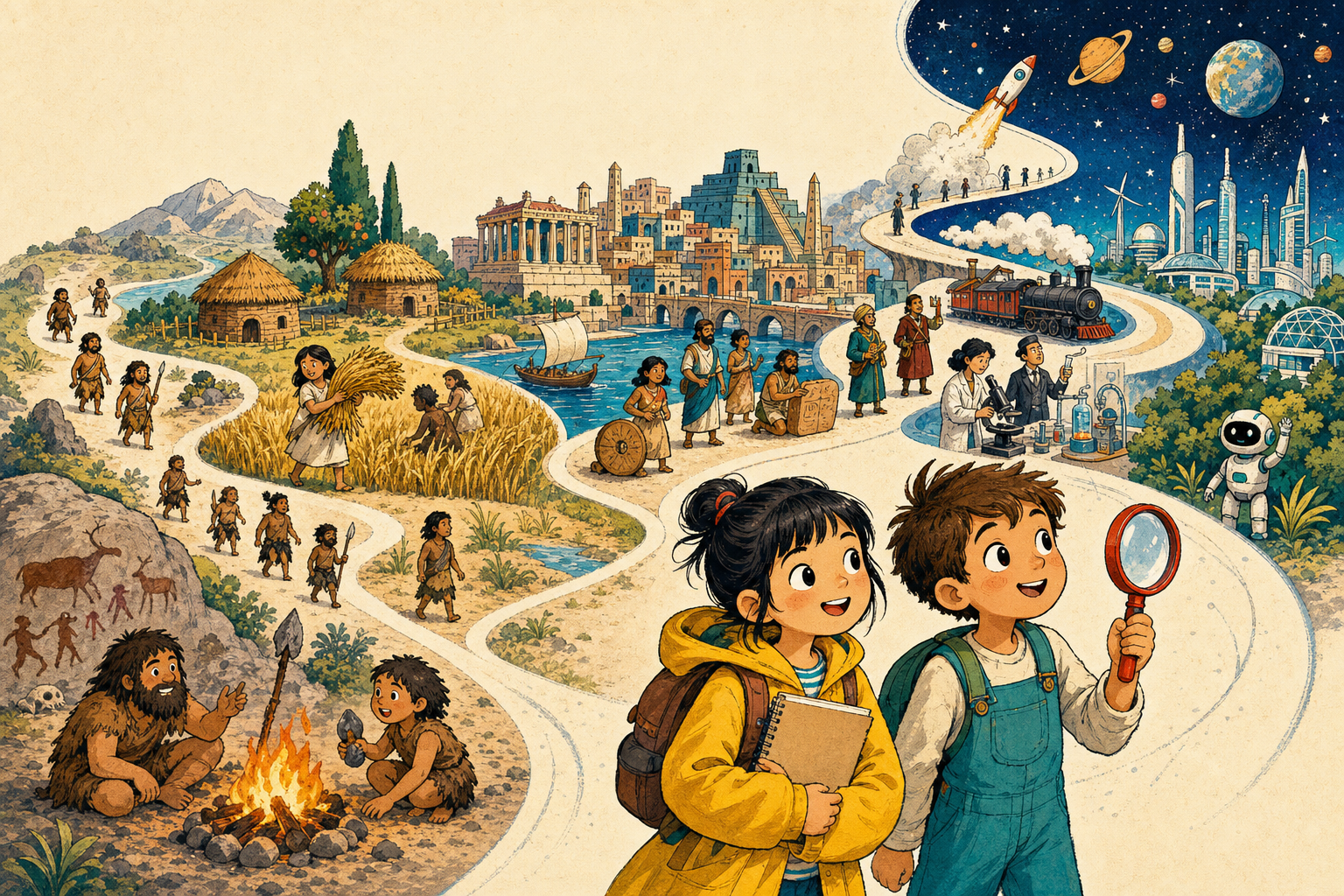
从史前火堆到未来城市的儿童漫画封面插图
看见全景SEE THE BIG PICTURE
READ THIS FIRST

这不是“标准答案”,而是一副思考眼镜。

哈拉瑞用很大的尺度,把生物学、历史、经济和哲学连成一个故事。下面的内容是他的观点的儿童友好改编:先学会复述,再学会问“真的吗?还有别的解释吗?”

先读画面合上复述分清证据与解释最后提问题
CHOOSE A PATH · 选择阅读路线

今天想怎么读?

不用一次读完 104 格。先选一条路,读懂比读多更重要。

THE BIG MAP · 人类大地图

一张图看懂全书四幕

不是背年份,而是追踪:新能力带来了什么,又让谁付出了代价?

合上页面,你能说出四幕吗?
DEEP DIVE · 小朋友最感兴趣的三问

先别急着背结论,先追问“我们从哪里来?”

这三页把古人类、尼安德特人和“共同虚构”拆得更慢一点:哪些是证据,哪些是解释,哪些问题还没有唯一答案。

3 组专题 × 8 格
three deep dives · 24 panels
先记住:“古人类”不是“半人半猿”,而是人类家族中已经消失或与我们分开的亲戚。这里会遇到南方古猿、能人、直立人、尼安德特人、丹尼索瓦人和智人,也会提到弗洛勒斯人、纳莱迪人等;这不是完整名单。科学家还会因为新化石和古 DNA 修改家族树。 Early humans were human relatives, not “half-apes”. This is a starter list, not a complete catalogue: Australopiths, Homo habilis, H. erectus, Neanderthals, Denisovans, Sapiens, and more.
F1

THE HUMAN FAMILY · 古人类家族

人类不是一条直线,而是一棵会分叉的家族树。

Human evolution is a branching family story, not a ladder.

超过 20 个已知亲戚
the count keeps changing
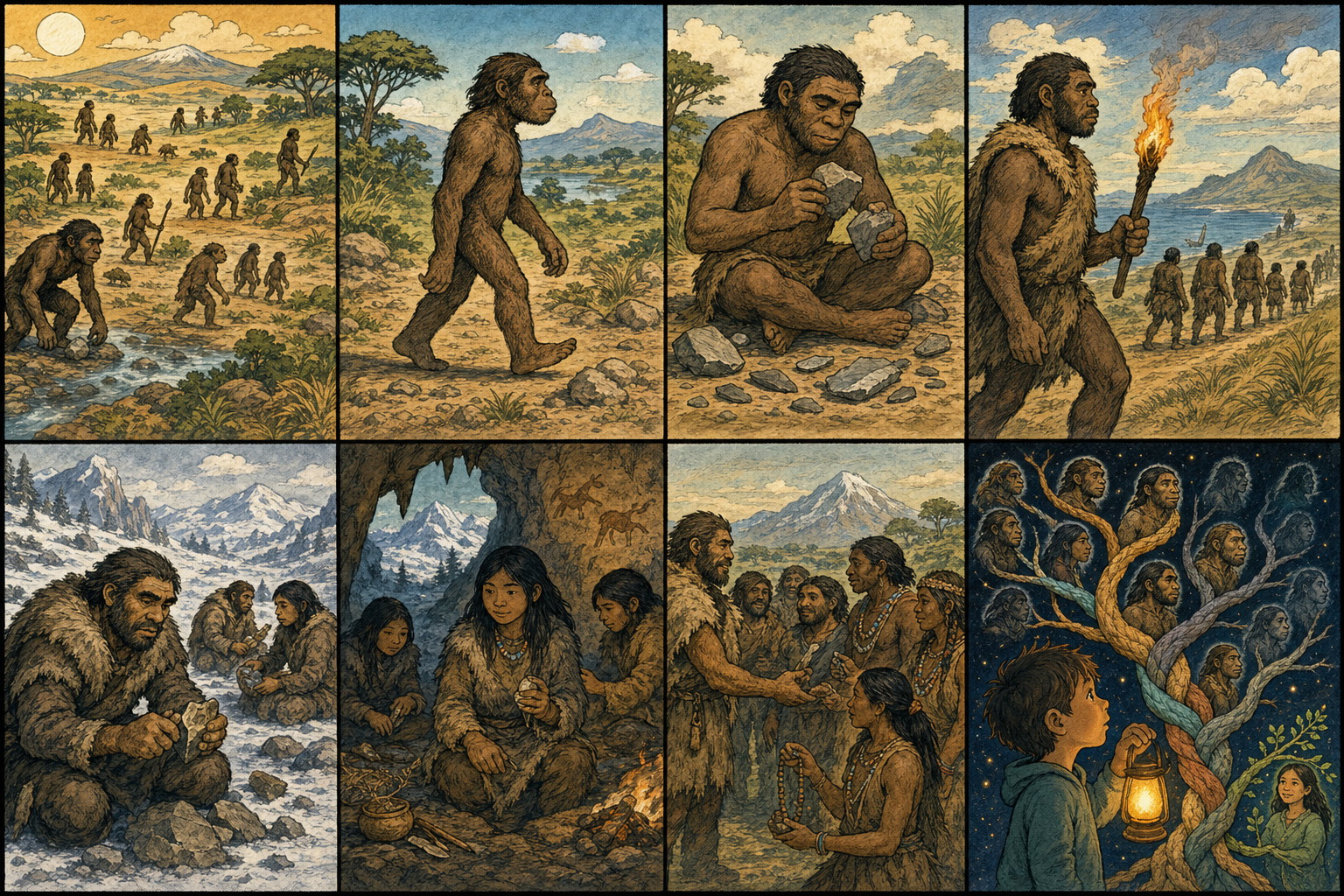
专题八格漫画:从南方古猿、能人、直立人到尼安德特人、丹尼索瓦人和智人的人类家族
BIG IDEA · 核心事实我们曾经和很多人类亲戚一起生活过;今天只剩智人这一支还活着,但其他支系并没有因此变得“低级”。Many human relatives once shared the planet with us. Sapiens is the only living human species today, but the others were not “less human”.
小朋友能复述

“进化不是排队比赛,而是分叉、适应,有时还会重新相遇。”

1人类家族不是一条从矮到高的直线。Our family is not a ladder from “low” to “high”.
2南方古猿等更早的亲戚已经会直立行走。Early relatives such as australopiths could walk upright.
3能人等早期 Homo 亲戚会制作石器。Early Homo relatives made stone tools.
4直立人用火、走得远,也生活了很久。Homo erectus used fire, traveled far and lasted a long time.
5尼安德特人适应寒冷,会打猎、用火、照顾同伴。Neanderthals adapted to cold, hunted, used fire and cared for others.
6丹尼索瓦人主要从古 DNA 和少量化石中被认识。Denisovans are known mostly through ancient DNA and a few fossils.
7智人大约 30 万年前在非洲出现。Homo sapiens appeared in Africa about 300,000 years ago.
8家族树会分叉,也会相遇、交换基因和文化。The family branches, meets again and exchanges genes and culture.
F2

SAPIENS & NEANDERTHALS · 智人和尼安德特人

“智人胜出”不是一场简单的决赛。

The story was not a simple final match between a winner and a loser.

约 4 万年前以后
their story overlapped
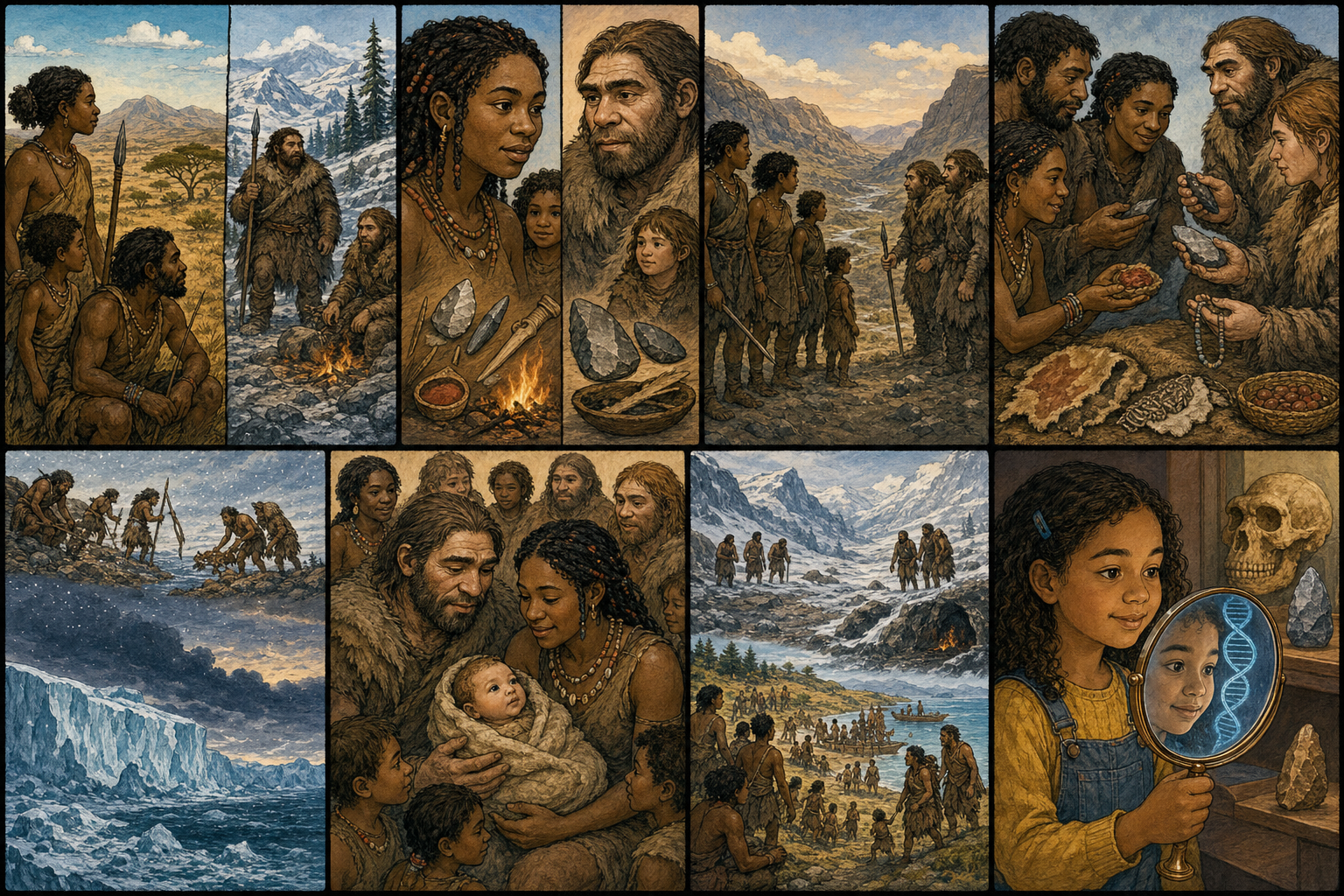
专题八格漫画:智人与尼安德特人的相遇、交流、竞争、混合与共同遗产
BIG IDEA · 书中观点 + 科学提醒哈拉瑞强调:智人能用共同故事组织大规模合作。科学研究则提醒:人口数量、社会网络、文化学习、环境变化与偶然机会可能共同参与;我们还不能把“胜出”归结为一个“聪明原因”。Harari emphasizes large-scale cooperation through shared stories. Research adds demography, networks, cultural learning, climate and chance — not one proven “smartness” switch.
最容易记住的关系

“尼安德特人不是笨人,也不是我们的爸爸妈妈;他们是很近的亲戚。相遇以后,部分基因进入了今天很多人的身体。”

1智人在非洲发展,尼安德特人在欧亚生活。Sapiens developed in Africa; Neanderthals lived in Eurasia.
2两边都会制作工具、用火,也有家庭和照顾。Both made tools, used fire, had families and cared for others.
3后来,两种人类亲戚在山谷里相遇。Later, the two human relatives met in the valleys.
4相遇可能带来交换:物品、知识和生活办法。Meetings could bring exchanges of objects, ideas and skills.
5也可能发生竞争;气候变化让日子更难。There was also competition, while climate made life harder.
6他们还曾经有过孩子,基因留下了线索。They also had children together, leaving genetic clues.
7尼安德特人群体变小、变分散;智人网络可能更大。Neanderthal groups became smaller and more isolated; Sapiens networks may have been wider.
8所以不是“他们全没了”:一部分遗产仍在我们身上。So they did not simply vanish: part of their legacy lives in us.
F3

SHARED IMAGINED ORDERS · 共同虚构

“虚构”不等于“没用”:共同相信,能变成社会现实。

“Imagined” does not mean useless; shared belief can create social reality.

每天都在发生
look around today
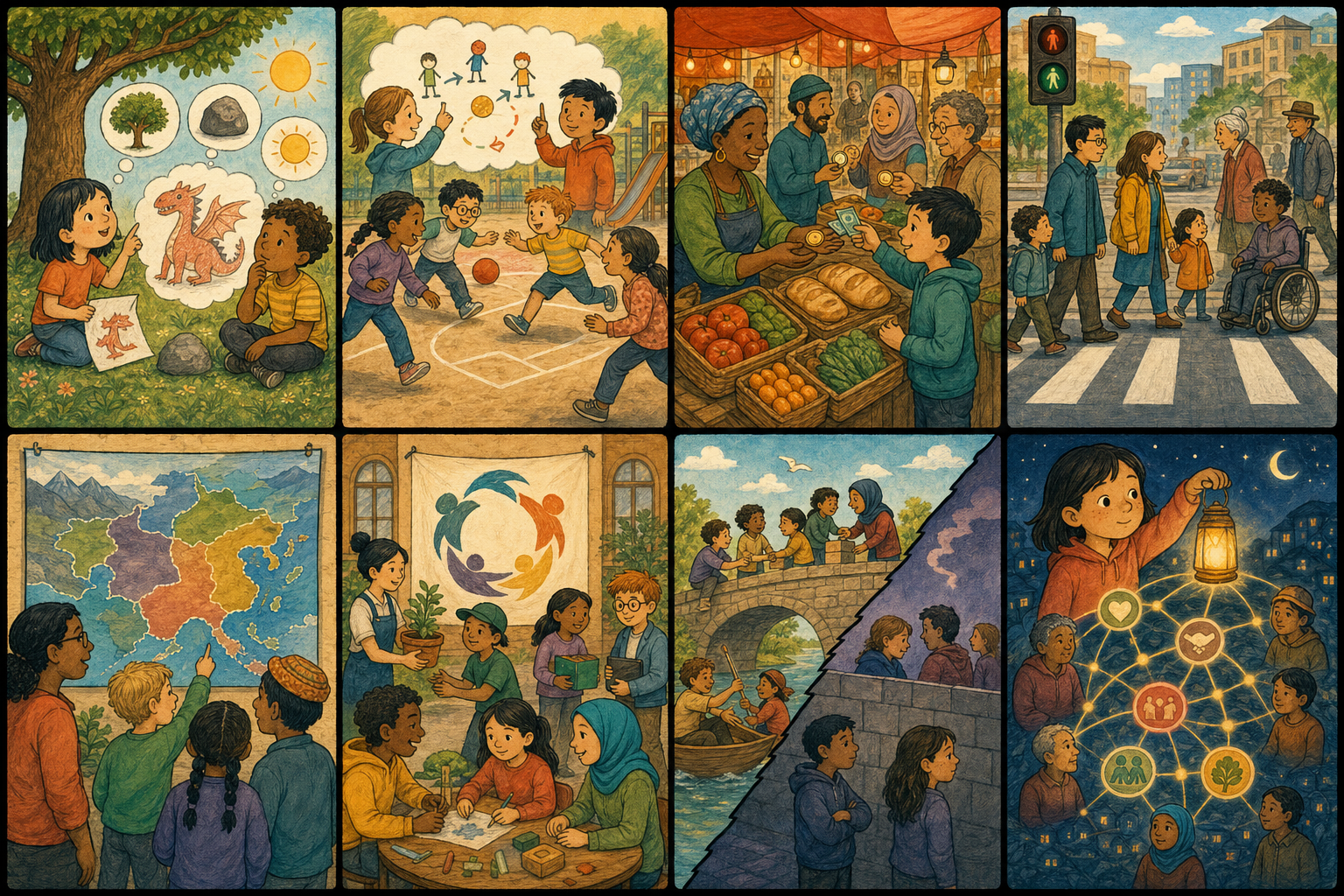
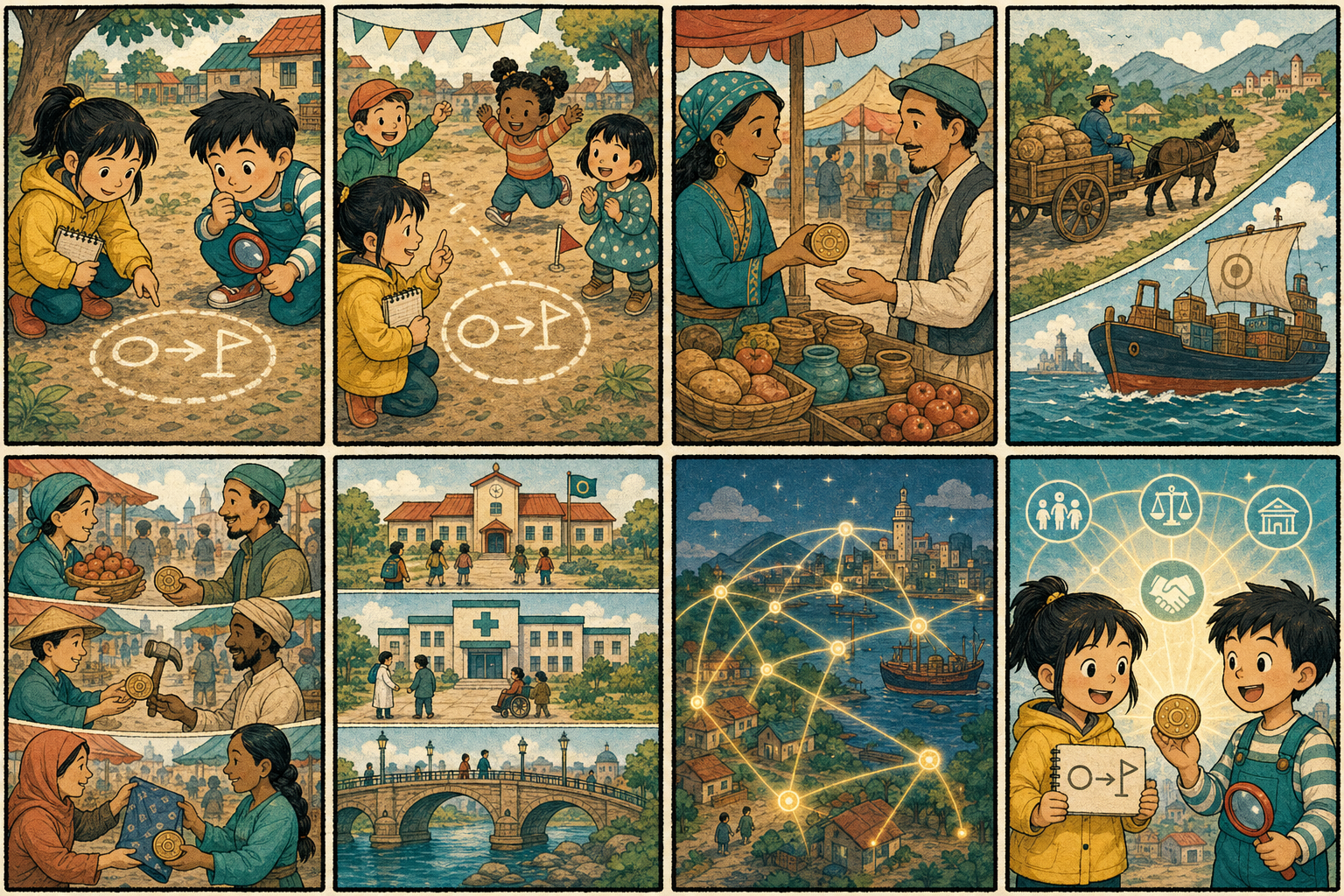
专题八格漫画:从游戏规则、金钱到法律、国家与机构的共同虚构
BIG IDEA · 解释框架哈拉瑞把这类东西称为“共同虚构”:它不是“纯粹的谎言”。树、石头和阳光不需要大家同意;钱、法律、国家和学校要靠很多人共同相信、共同遵守,才能运转。Harari calls these “shared imagined orders”. They are not simply lies: money, laws, nations and schools work because many people share and follow them.
小朋友能复述

“共同虚构像一条大家一起画出来的线:它看不见,却能让陌生人合作;也要检查它是否公平、是否排除了别人。”

1树和石头在那里,不用大家投票才存在。A tree and a rock do not need a vote to exist.
2孩子们约定游戏规则,游戏立刻变得可一起玩。A shared game rule lets children play together.
3钱本身只是一张纸或一块金属。Money is physically only paper or metal.
4因为大家信它,陌生人也能用它交换。Because people trust it, strangers can exchange it.
5法律和交通规则让很多人协调行动。Laws and traffic rules coordinate many people.
6国家、学校和公司也是由共同规则组织起来的。Nations, schools and companies are organized by shared rules.
7共同故事能搭桥,也可能画出“我们”和“他们”的墙。Shared stories can build bridges — or walls between “us” and “them”.
8真正重要的问题是:这个故事公平、善良、对所有人开放吗?The key question is: is the story fair, kind and open to everyone?
THE COMIC WALK · 漫画漫游

每一页,读懂一个大想法

每个章节都是 8 格:一格一个动作,一步一步把观点讲清楚。

往下翻页 / SCROLL TO READ
01

THE COGNITIVE REVOLUTION · 认知革命

人类最强的“工具”,可能是共同的故事。

Our superpower may be the stories we can share.

约 7 万年前
about 70,000 years ago
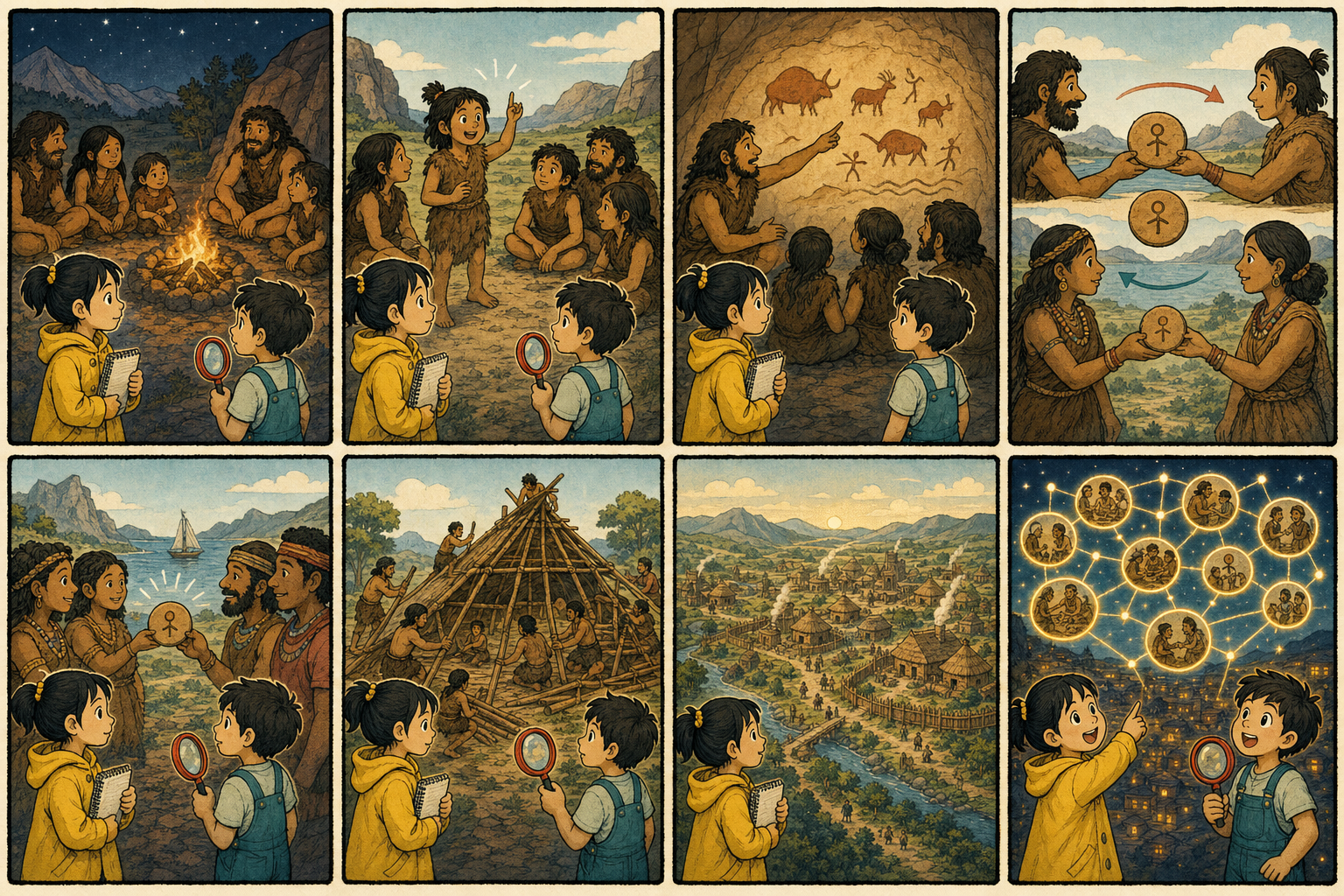
八格漫画:人类从小群体通过故事发展出大规模合作
BIG IDEA我们能让陌生人相信同一个看不见的东西,于是可以一起做大事。Shared stories let strangers cooperate at a huge scale.
小朋友能复述

“故事不是只有童话;规则、身份和共同目标,也能把很多人连在一起。”

1先是一个小小的群体。It begins with a small group.
2手势让大家理解同一个意思。A gesture gives everyone the same idea.
3故事让脑海里出现同一幅画。A story puts one picture in many minds.
4符号可以把意思带到远方。A symbol can travel far.
5陌生人也能认出共同的信号。Strangers can recognize a shared signal.
6于是,大家能一起完成大工程。Then people can build big things together.
7小群体慢慢变成大社会。Small groups can grow into societies.
8想象力变成了合作网络。Imagination becomes a network of cooperation.
02

THE AGRICULTURAL REVOLUTION · 农业革命

种下小麦,也种下了一种生活方式。

Farming brought more food — and a new kind of work.

约 1.2 万年前
about 12,000 years ago
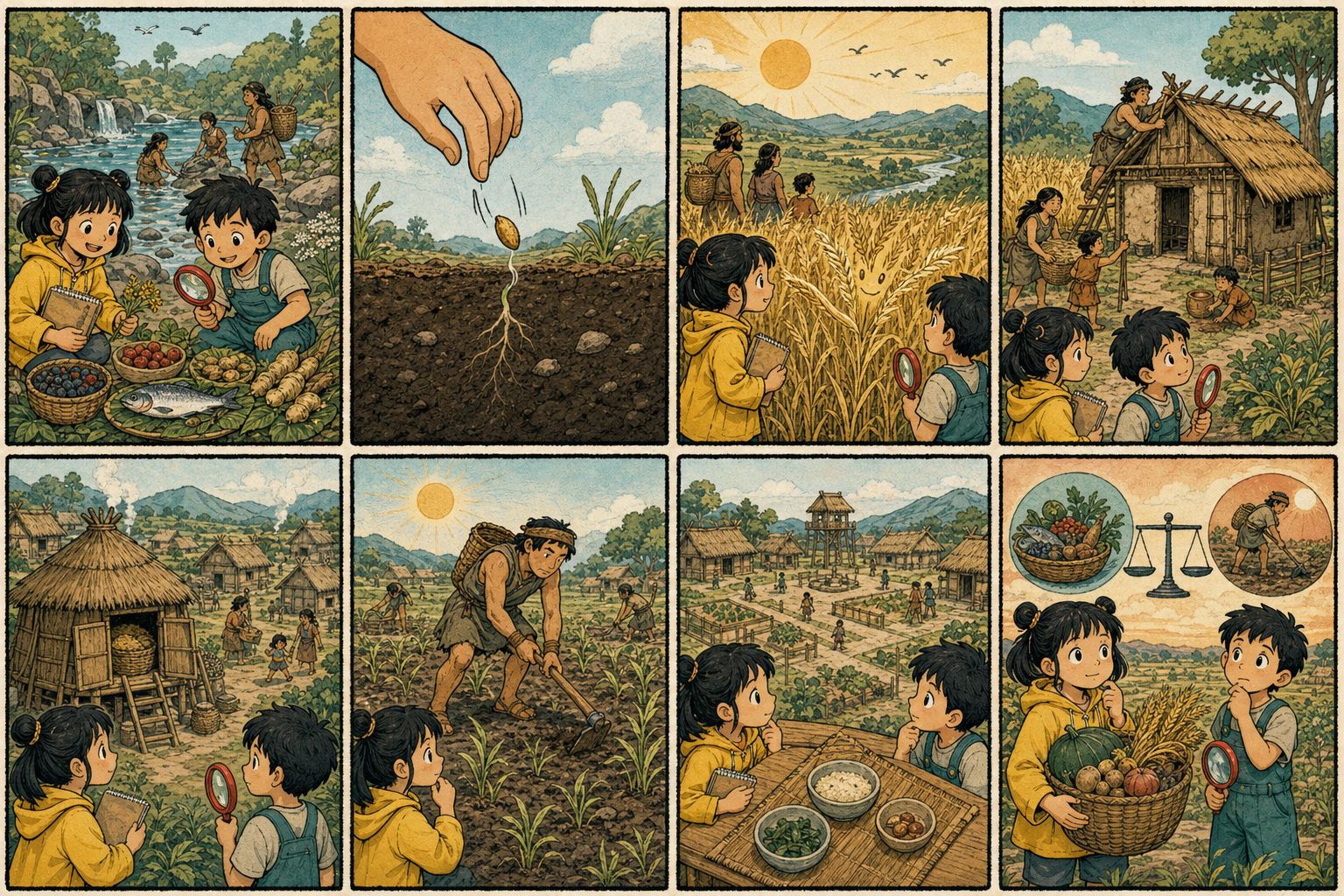
八格漫画:农业带来食物与村庄,也带来重复劳动
BIG IDEA农业让人口和村庄变大,但不一定让每个人的日子更轻松。More food and more people did not always mean an easier life.
小朋友能复述

“一个改变可能同时有好处和代价。问‘谁得到了什么?谁付出了什么?’”

1流动的人们吃很多不同的食物。Foragers eat many different foods.
2一颗种子落进了土里。A seed falls into the soil.
3小麦越来越多,也把人留在原地。Wheat grows — and keeps people in one place.
4人们盖房子,开始定居。People build homes and settle down.
5村庄变大,粮仓装满。Villages grow and granaries fill.
6但重复的劳动也变多了。But repetitive work grows too.
7生活更有秩序,也更依赖少数作物。Life is organized — and depends on fewer crops.
8进步,常常是一笔有代价的交换。Progress can be a trade-off.
03

IMAGINED ORDERS · 共同秩序

钱、规则和学校:看不见,却能一起行动。

Money and rules work when people trust the same system.

每一天
everyday systems
八格漫画:共同规则和金钱让陌生人可以协作
BIG IDEA共同相信一套规则,能把陌生人连接起来;钱就是一种特别强的共同信任。Shared trust connects strangers; money is a powerful form of that trust.
小朋友能复述

“钱不是魔法,它要靠大家都愿意相信、接受和交换。”

1先从“大家都同意的规则”开始。It starts with a rule everyone accepts.
2规则让更多人加入同一个游戏。A rule lets more people join the game.
3陌生人用一枚普通的硬币交换。Strangers exchange a simple coin.
4硬币可以一路走到很远的地方。The coin can travel a long way.
5不认识彼此,也能做生意。People can trade without knowing each other.
6共同的规则还能建起学校和桥。Shared rules can build schools and bridges.
7信任像一张看不见的网。Trust is an invisible web.
8但只有“共同相信”,系统才会运转。The system works only while trust is shared.
04

EMPIRE & LARGE SYSTEMS · 大系统

文字、宗教与帝国,把许多人装进同一套秩序。

Writing, religions and empires connect people — and can concentrate power.

历史长河
across long history
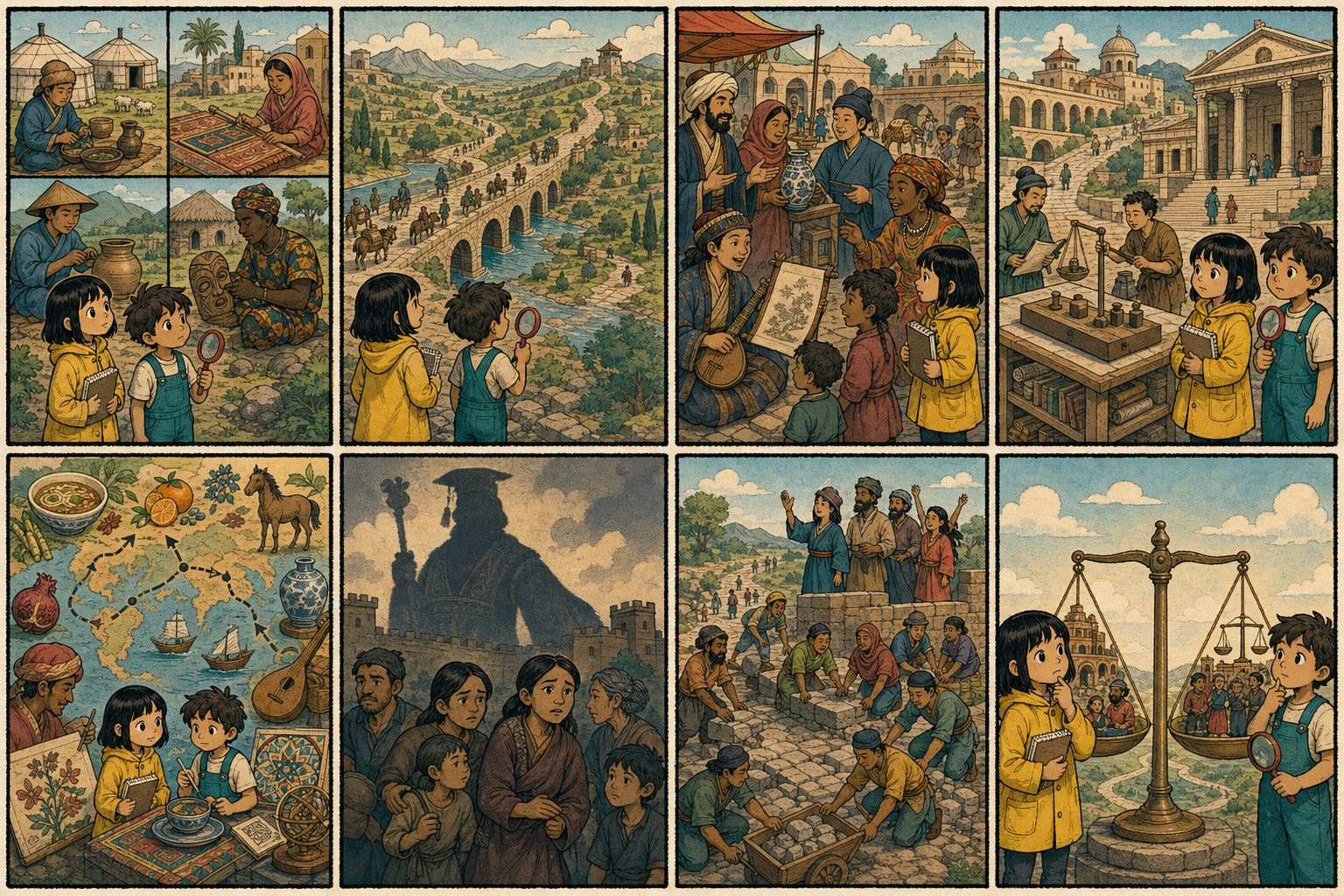
八格漫画:大系统连接不同人群,也带来权力与公平问题
BIG IDEA文字和数字帮助记录大社会;宗教提供共同价值;帝国连接不同文化,也常通过征服集中权力。大,不自动等于公平。Writing and numbers administer large societies; religions offer shared values; empires connect cultures and often concentrate power through conquest. Bigger is not automatically fairer.
小朋友能复述

“连接和公平是两个问题。路修得更远,不代表每个人都被同样对待。”

1不同的小社区,各有自己的生活。Small communities live in different ways.
2道路和桥把它们连起来。Roads and bridges connect them.
3旅行者、商人和故事相遇。Travelers, traders and stories meet.
4共同的建筑和标准开始出现。Shared buildings and standards appear.
5食物、艺术和发明互相流动。Food, art and inventions travel.
6但权力变大,也可能变得不平等。Power can grow — and become unequal.
7人们可以合作,也可以争取公平。People can cooperate and ask for fairness.
8大,不等于好;连接要和公平一起看。Big is not always good; connection needs fairness.
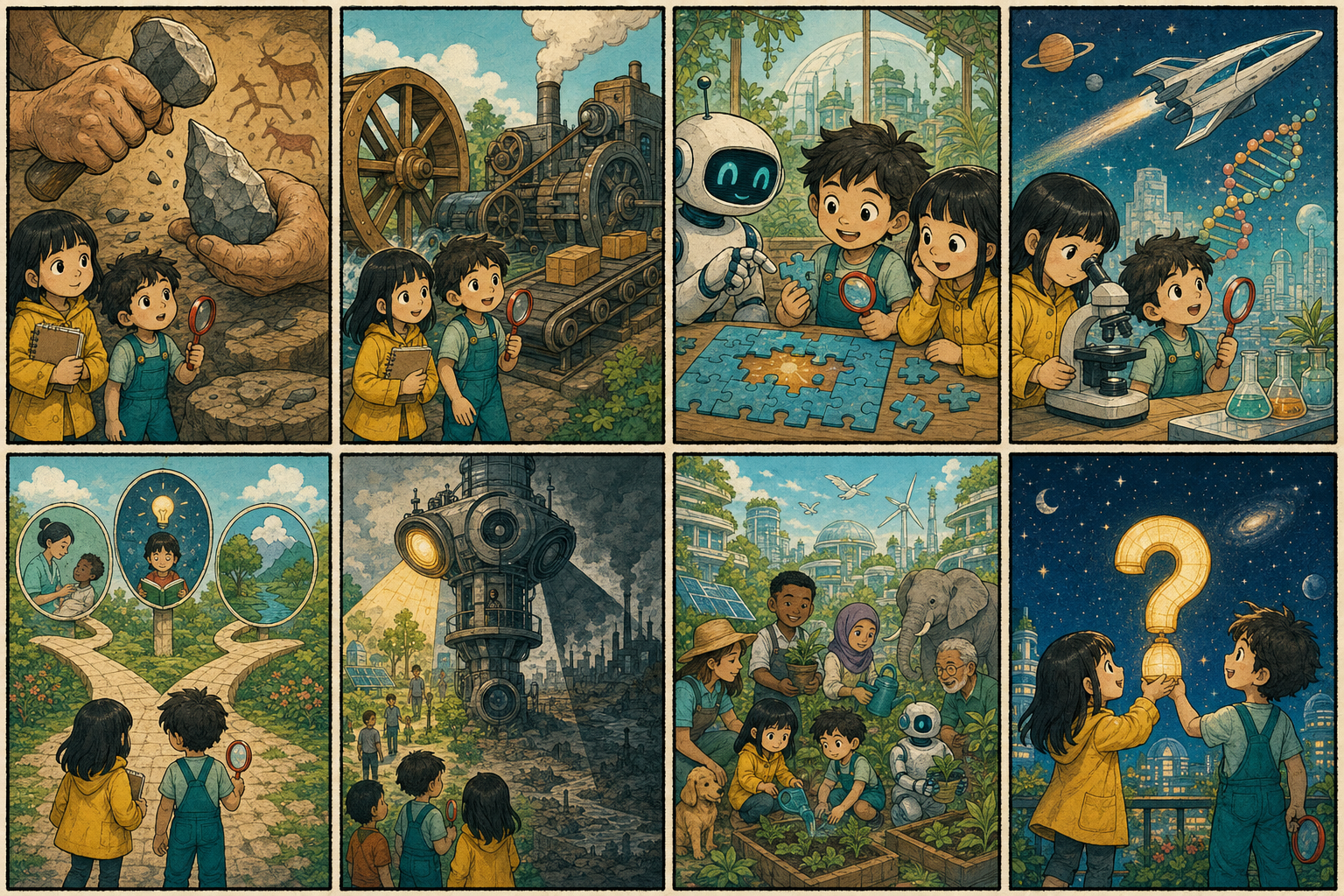
05

THE SCIENTIFIC REVOLUTION · 科学革命

科学从一句诚实的“我不知道”开始。

Science begins when we admit what we do not know.

约 500 年前
about 500 years ago
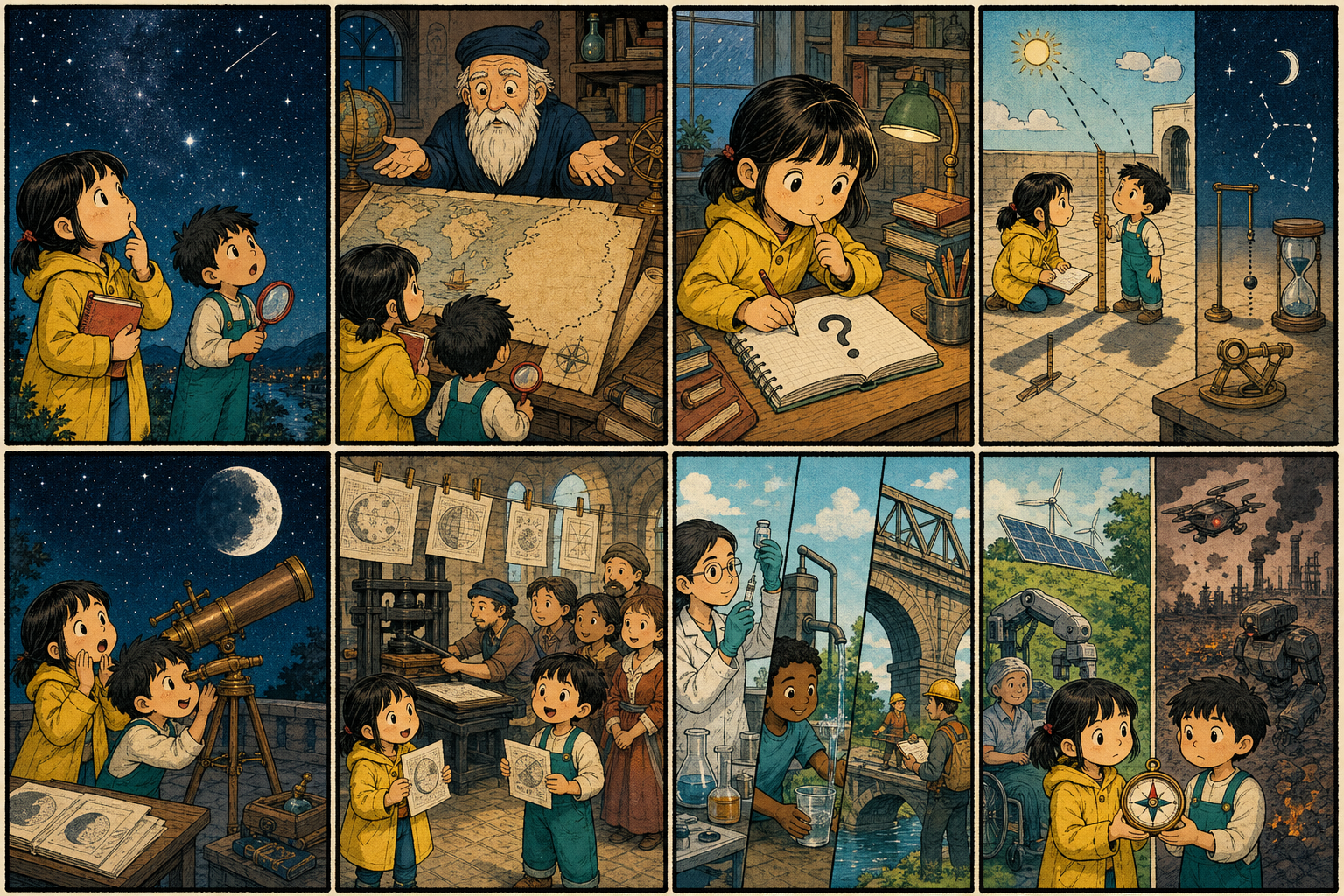
八格漫画:从承认未知到测量、实验与技术
BIG IDEA好奇心 + 测量 + 实验,让我们获得了改变世界的力量;力量越大,越需要负责。Curiosity, measurement and experiments bring power — and responsibility.
小朋友能复述

“不知道不是丢脸。把问题问清楚,再用证据检查答案。”

1抬头看星星,先产生问题。Look up and start with a question.
2面对未知,可以诚实地说“不确定”。It is honest to say “I’m not sure.”
3把问题写下来,变得更清楚。Writing a question makes it clearer.
4用工具测量,而不是只猜。Measure with tools instead of guessing.
5实验可能带来意外的新发现。Experiments can reveal surprises.
6把发现分享出去,更多人能学习。Sharing discoveries lets more people learn.
7科学能帮助我们治病、出行、建造。Science can help us heal, travel and build.
8能力越强,越要同时想后果。The more power we have, the more we must consider consequences.
06

THE HAPPINESS QUESTION · 幸福问题

拥有更多,不自动等于感到更幸福。

More power and convenience do not automatically mean more happiness.

一直到今天
still our question
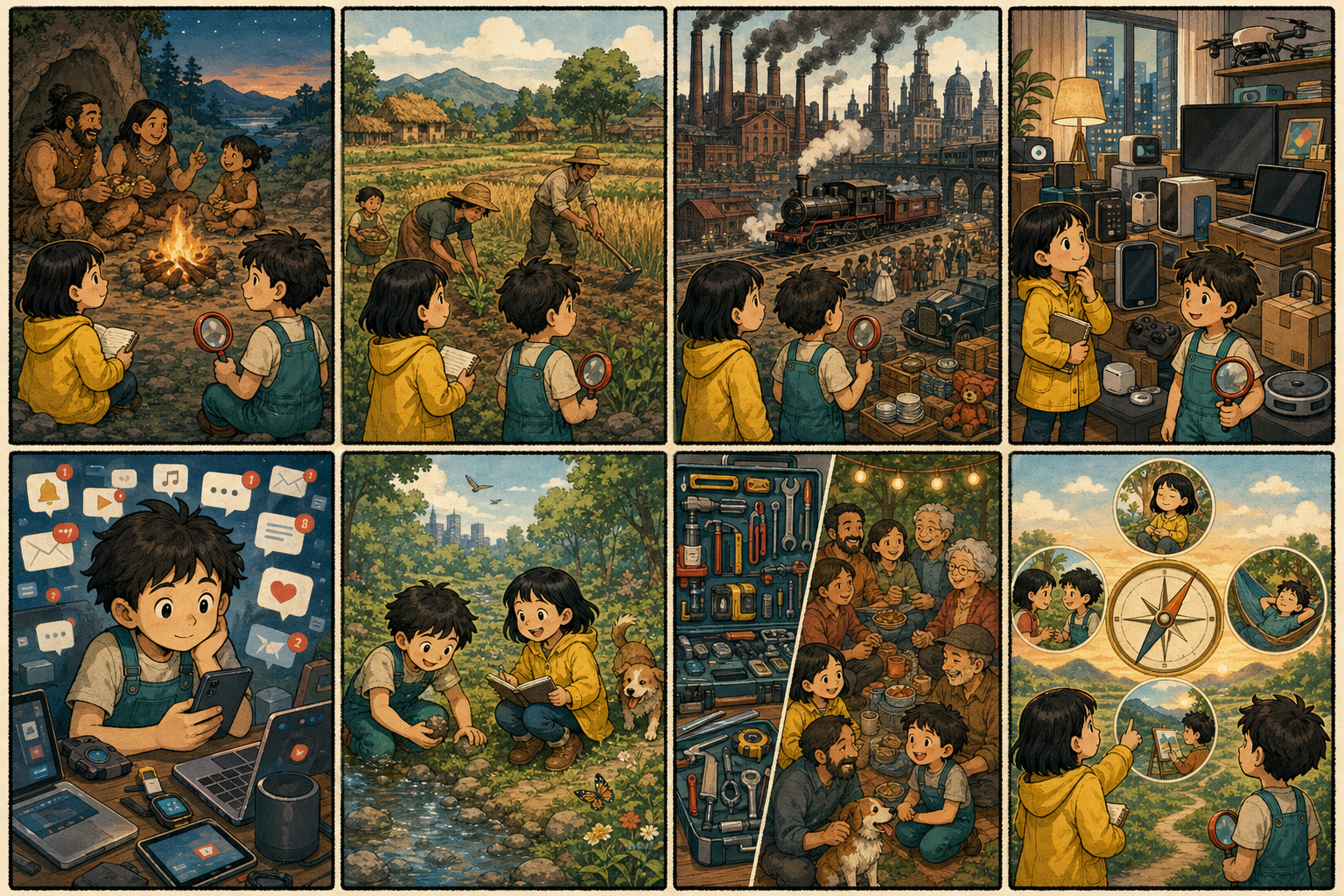
八格漫画:生产力和便利增加后,人们仍要追问幸福是什么
BIG IDEA历史不只要问“人类变强了吗”,还要问“人类过得好吗”。History should ask not only “Are we stronger?” but also “Are we well?”
小朋友能复述

“工具能帮忙,但幸福还和关系、注意力、休息、意义有关。”

1一个故事和一顿分享的饭,也能让人开心。A story and shared food can bring joy.
2新的生活方式带来新的工作。New ways of living bring new work.
3城市和工厂让物品越来越多。Cities and factories make more goods.
4便利进入了每个房间。Convenience enters every room.
5但太多提醒也会让人分心。Too many alerts can split our attention.
6放下屏幕,朋友和自然又回来了。Put the screen down; friends and nature return.
7满满的工具,和满满的心,不是一回事。A full toolbox is not a full heart.
8我们要自己定义“过得好”。We must define what “doing well” means.
07

THE FUTURE QUESTION · 未来问题

当我们越来越强,要选择成为什么样的人。

As our powers grow, we must choose what kind of future to build.

下一页
the next page is ours
八格漫画:科技让人变得更强,也要求我们做出有责任的选择
BIG IDEA科技可以放大能力,却不会替我们决定什么值得追求。Technology can amplify power, but it cannot choose our values for us.
小朋友能复述

“未来不是自动发生的。我们可以一起讨论:想保护什么,想成为什么?”

1人类先用双手做出工具。Humans first made tools with their hands.
2机器让我们做得更快、更远。Machines help us go faster and farther.
3人和机器人可以一起解决问题。People and robots can solve problems together.
4新技术甚至可能改变我们的能力。New technology may change our abilities.
5每一条路,都有不同的选择。Every path contains choices.
6强大的工具既能帮助,也能伤害。Powerful tools can help or harm.
7未来需要人、机器和自然一起被照顾。The future must care for people, machines and nature.
8下一章由我们来写。We get to write the next chapter.
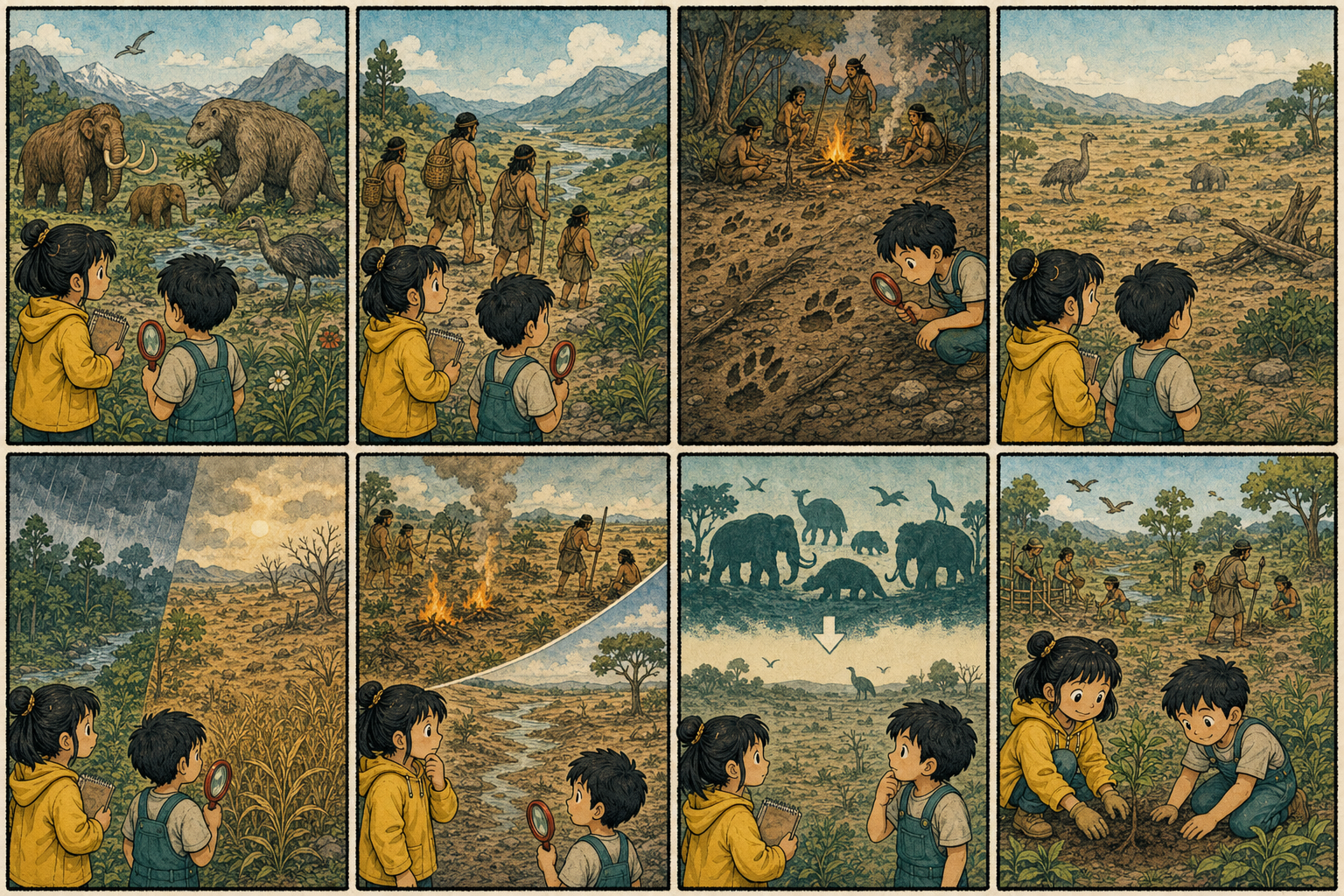
08

ECOLOGY & EXTINCTION · 生态与灭绝

智人走到哪里,哪里就不只多了篝火。

Human migration changed ecosystems as well as human history.

数万年之间
across many migrations
八格漫画:智人迁徙、环境变化与大型动物减少,以及今天的生态责任
BIG IDEA · 核心观点哈拉瑞提醒我们:智人很早就是改变生态的力量。许多大型动物的消失,可能同时受到人类活动和环境变化影响。Harari reminds us that Sapiens became an ecological force early. Human activity and environmental change may both have contributed to many extinctions.
小朋友能复述

“人类历史不只发生在人类之间;动物、植物和气候也在故事里。”

1从前,许多大陆生活着更多大型动物。Many continents once held more kinds of large animals.
2智人带着工具和篝火进入新地方。Sapiens entered new lands with tools and fire.
3捕猎和烧荒会改变动物的生存压力。Hunting and landscape burning changed survival pressures.
4一些动物的数量一代代减少。Some animal populations shrank over generations.
5同时,气候也在改变森林和草原。Climate was also reshaping forests and grasslands.
6不同地方的原因组合可能不同。The mix of causes differed from place to place.
7“人类成功”可能是其他生命的代价。Human success could carry costs for other life.
8知道过去,是为了今天做更负责的选择。Knowing the past can guide more responsible choices today.
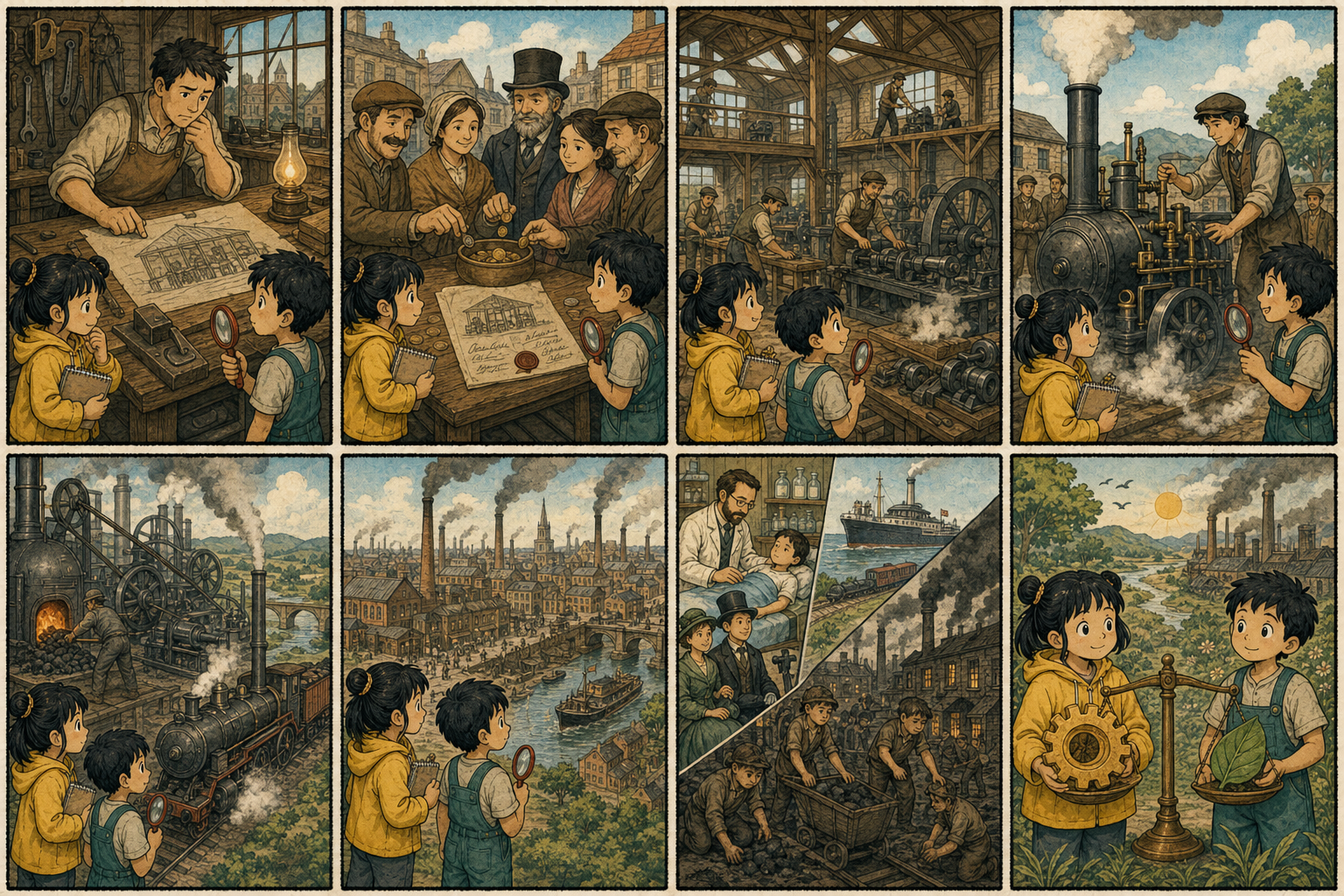
09

CREDIT & INDUSTRY · 信用与工业

当人们相信“明天会更大”,未来也能借来使用。

Credit turns trust in future growth into resources today.

近 500 年
the modern growth loop
八格漫画:信用支持发明,科学、资本和能源推动工业,也带来污染与不平等
BIG IDEA · 核心观点信用把“相信未来”变成今天的资源;科学、资本与新能源互相推动,生产力飞快增长,代价也被放大。Credit turns belief in the future into resources now. Science, capital and new energy reinforced one another, amplifying both production and its costs.
小朋友能复述

“信用不是白送的钱,而是用对未来的信任交换今天的机会和风险。”

1一个好点子,常常先缺工具和材料。A good idea often begins without enough tools or materials.
2信用让别人把资源交给一个未来计划。Credit lets others support a plan for the future.
3投资让工坊扩大,也带来偿还压力。Investment can grow a workshop and create repayment pressure.
4实验与发明找到利用能源的新办法。Experiments find new ways to use energy.
5蒸汽、煤和机器让生产速度跃升。Steam, coal and machines accelerate production.
6物品、城市和交通迅速增加。Goods, cities and transport expand rapidly.
7便利增加,污染、劳累和差距也可能增加。Convenience grows, but so can pollution, exhaustion and inequality.
8真正的问题不是“要不要增长”,而是“为了什么”。The deeper question is what growth should be for.
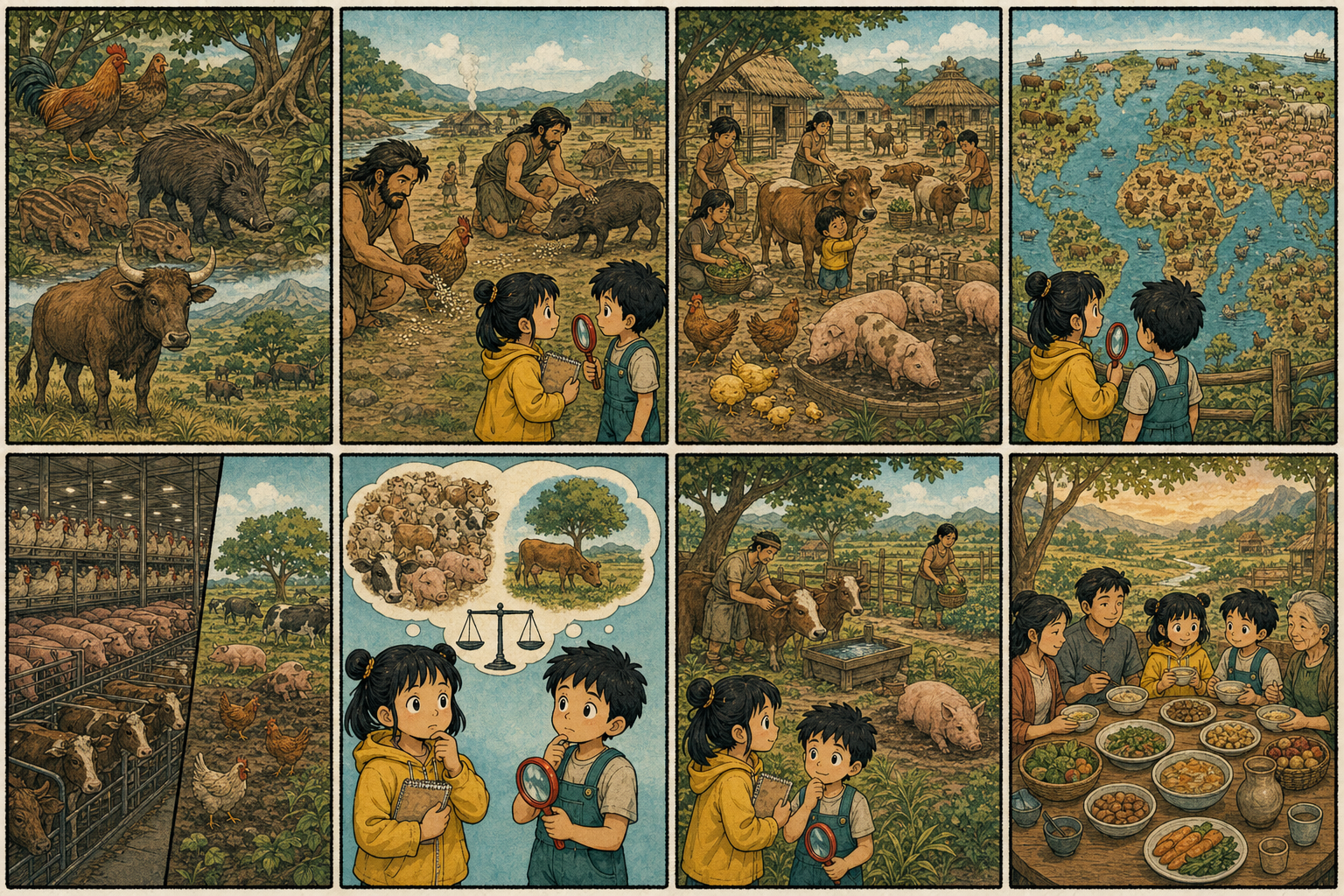
10

ANIMALS & OUR CHOICES · 动物与我们的选择

一个物种数量很多,不等于每个生命都过得好。

A species can be numerous while individual animals live poorly.

农业至今天
from domestication to now
八格漫画:动物驯化、数量增长、集约饲养和改善动物生活的选择
BIG IDEA · 核心观点驯化动物在数量上非常“成功”,但哈拉瑞要求我们把镜头拉近:单个动物是否能活动、休息、照顾幼崽、免于痛苦?Domesticated animals are extremely “successful” in number. Harari asks us to zoom in: can each animal move, rest, care for young and avoid suffering?
小朋友能复述

“评价历史不能只数数量,还要看每个生命的感受和生活质量。”

1家鸡、猪和牛都有生活在野外的祖先。Chickens, pigs and cattle have wild ancestors.
2人类用食物和保护,慢慢改变了它们。Food and protection gradually changed their lives.
3动物帮助农耕,也成为村庄生活的一部分。Animals supported farming and village life.
4今天,驯化动物的数量极其庞大。Today, domesticated animals exist in enormous numbers.
5高效率的饲养可能限制自然行为。Highly efficient farming can restrict natural behavior.
6“更多”与“过得更好”是两个问题。“More” and “living better” are different questions.
7空间、清水、遮阴和照顾可以减少痛苦。Space, clean water, shade and care can reduce suffering.
8我们可以了解来源,再做有同理心的选择。We can learn where food comes from and choose with empathy.
THREE MISSING LINKS · 补上三块关键拼图

读懂全书,还要看见这三股力量

它们不需要再增加 24 格漫画,却是理解“人类大融合”和现代生活的重要桥梁。

01 · 共同价值宗教与意识形态Religion & ideology

在哈拉瑞的框架里,宗教不只指“相信神”,也包括大家共同相信的价值和规则。它们能让陌生人互相帮助,也可能把人分成“我们”和“他们”。In Harari’s framework, religion includes shared values and rules, not only belief in gods. It can unite strangers and also divide “us” from “them”.

孩子要会问 · ASK它让谁团结?又可能排除谁?Whom does it unite—and whom might it exclude?
02 · 真实后果想象的等级Imagined hierarchies

阶层、种族和性别等级并不是石头那样的自然事实,却会通过法律、习惯和机会产生真实后果。共同相信,不代表公平或不能改变。Class, racial and gender hierarchies are not natural objects, yet they create real effects through law, custom and opportunity. Shared belief does not make them fair or unchangeable.

孩子要会问 · ASK谁制定规则?谁得到更多机会?Who makes the rules, and who gets more opportunity?
03 · 现代生活国家、市场与个人State, market & individual

哈拉瑞认为,现代国家和市场接手了许多过去由家庭和社群承担的任务,也让“个人选择”更重要,同时带来消费压力和新的孤独。Harari argues that modern states and markets took over many roles once held by family and community, expanding individual choice while adding consumer pressure and new loneliness.

孩子要会问 · ASK自由增加时,我们失去了哪些连接?As freedom grows, which connections might weaken?
THINK LIKE A HISTORIAN · 像历史学家一样想

没有标准答案的六个问题

先说自己的理由,再打开“对话线索”。好的问题会让一家人继续聊下去。

01 · 亲戚尼安德特人的消失,真的等于“失败”吗?Does disappearance really mean failure?

对话线索:他们曾适应严寒、照顾同伴,也和智人留下共同后代。我们用什么标准定义“成功”?

02 · 信任如果钱明天消失,陌生人还能怎样合作?How could strangers cooperate without money?

对话线索:交换、记录、信誉、礼物或共同规则,分别有什么优点和难题?

03 · 代价农业是人驯化了小麦,还是小麦改变了人?Did humans domesticate wheat—or vice versa?

对话线索:分别从小麦、农民、儿童、动物和村庄的角度说一遍。

04 · 公平一个共同故事什么时候是桥,什么时候会变成墙?When does a shared story become a bridge or a wall?

对话线索:它让谁加入合作?谁被挡在外面?规则能不能被讨论和修改?

05 · 生命数量更多,是否代表生活更好?Does “more” mean “better lives”?

对话线索:把这个问题分别问人、家畜、野生动物和一片森林。

06 · 未来如果科技让我们无所不能,最先该决定什么?If we could do anything, what should we decide first?

对话线索:先问“我们想保护什么”,再问“我们能制造什么”。

内容只保存在这台设备上。

THE SAPIENS QUEST · 人类简史终章闯关

你是真的懂了,还是只是看过了?

三回合、12 道关键题。答错不会扣分:看提示、重新推理,直到找到更完整的解释。

历史最佳
0 / 12 星火

不是记忆比赛

带上三件工具:看图、找证据、想代价。

12 道关键题3 个回合 不限时间

READING NOTE · 读书说明

关于这份儿童版

本页不是原书摘录,也不是完整历史教科书,而是适合亲子共读的“观点地图”。页面把较可靠的证据、哈拉瑞的解释框架和仍可追问的问题分开呈现。哈拉瑞的宏大叙事很有启发性,也常被学者批评过度简化;请把它当作一副思考眼镜,而不是唯一答案。